
Choosing the right Vacuum Seal Pouches can protect product quality, reduce waste, and improve customer confidence. However, the best pouch is not always the thickest or most expensive option. Product type, storage conditions, sealing equipment, and distribution time all influence the decision.
Small details matter. A pouch for fresh meat may need strong puncture resistance and reliable seals. A pouch for coffee may require excellent oxygen and moisture barriers. Dry goods often need different protection from oily or sharp-edged products. Consider the pouch material, thickness, dimensions, transparency, and temperature tolerance before placing a large order. Fit is everything. Excess space can weaken presentation, while a tight fit may stress the seal during handling. In practical packaging work, small samples often reveal problems that specifications miss.
Seal performance deserves careful attention. Check whether the pouches match your chamber or external vacuum machine. Test seal width, vacuum strength, leakage, and product movement after sealing. Then examine the package after refrigeration, freezing, transport, or shelf storage. Test before scaling.
A dependable supplier should provide clear material details, usage guidance, quality records, and consistent batch performance. Food-contact or other applicable compliance documentation may also be necessary for your market. Do not rely only on attractive photographs or broad performance claims. Ask precise questions and request samples. The choice may still involve compromise. A stronger barrier can increase cost, and a highly transparent structure may offer less protection. Reviewing these trade-offs honestly helps you select Vacuum Seal Pouches that suit real operating conditions, not just an ideal sample on a desk.
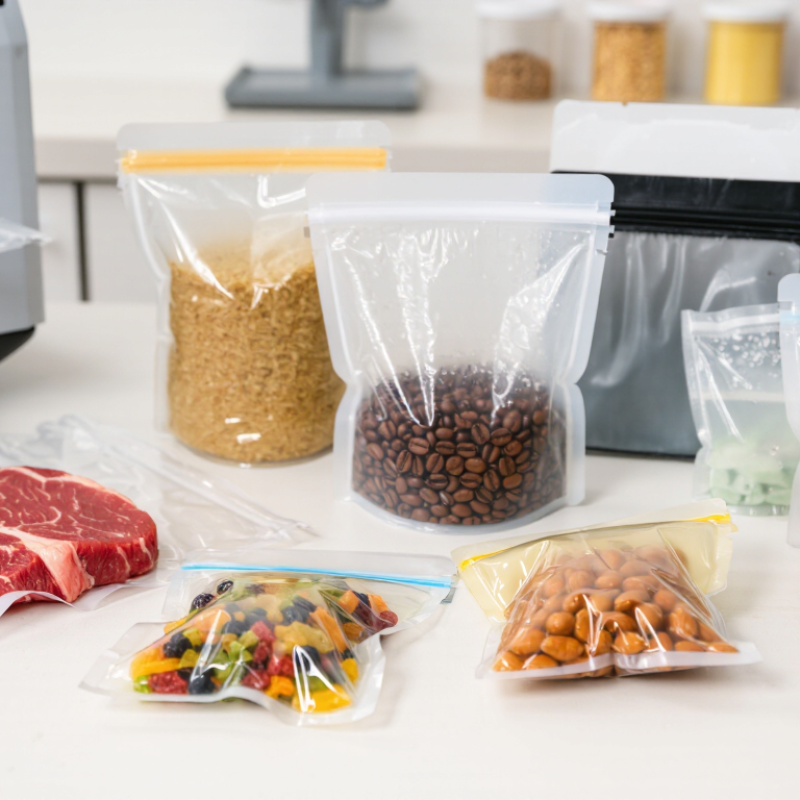
Choosing a vacuum pouch starts with the product, not the pouch price. Moisture, oxygen, light, aroma, and puncture resistance shape the material choice. Polyethylene usually forms the seal layer. Polyamide adds toughness and puncture resistance. EVOH provides strong oxygen protection, but humidity can reduce its performance. Foil blocks light and gases effectively, though it may crack when sharply folded. That trade-off matters when packing bones, frozen edges, or rigid food pieces.
UNEP’s Food Waste Index Report 2024 estimates that 1.05 billion tonnes of food were wasted in 2022. FAO’s 2019 report estimated that 14% of food is lost between harvest and retail. A suitable barrier can slow oxidation and moisture migration, but packaging alone cannot prevent waste. Measure oxygen transmission rate and water vapor transmission rate. Lower values generally indicate stronger barrier performance. ASTM F1927 supports oxygen-transmission testing, but test conditions must be examined carefully. A pouch tested at 23°C and 50% relative humidity may behave differently in a humid warehouse.
Seal integrity deserves equal attention. A perfect film fails with a weak seal. Check seal width, channel contamination, vacuum level, and drop resistance using the actual product. I have seen clean laboratory samples mislead teams. Real edges are messier. Run trials with sharp contents, oily surfaces, and extended storage periods. Then compare barrier results, seal failures, handling damage, and total material use before selecting the final structure.
How to Choose Vacuum Seal Pouches for Your Products?
Matching pouch size and strength to the product prevents wasted film, weak seals, and avoidable transport damage. A 2024 Grand View Research report valued the global vacuum packaging market at about $29.6 billion in 2023. That growth reflects demand for longer shelf life and efficient packing. However, a larger pouch is not automatically safer.
Measure the product at its widest and tallest points. Add enough clearance for smooth loading and a clean seal, but avoid excessive empty space. For example, a 250-gram coffee portion may need a pouch only slightly wider than the product. Too much film can create folds near the seal. Those folds may trap air or reduce seal reliability. Keep the seal area flat. Small details matter.
Choose material strength according to contact risks. Smooth meat cuts may need moderate puncture resistance, while products with bones, corners, or hard particles need tougher multilayer film. The seal must also match the product’s moisture and fat content. A 2023 report from Smithers identified barrier performance and packaging durability as continuing priorities in flexible packaging development. Test samples under real conditions: vacuum, chilling, stacking, and handling. I once focused only on film thickness and overlooked the seal width. That was a useful mistake. Thicker film cannot repair poor sizing or inconsistent sealing. Brief trials often reveal more than specifications alone.
| Product Type | Typical Product Size | Recommended Pouch Size (Width × Length) | Suggested Film Thickness | Recommended Structure | Strength Requirement | Key Selection Considerations |
|---|---|---|---|---|---|---|
| Sliced Meat, Cheese and Deli Foods | Up to 180 × 130 × 35 mm | 200 × 300 mm | 70–90 microns | PA/PE, low- to medium-barrier | Standard puncture resistance | Choose a pouch that leaves approximately 50–75 mm of material above the product for sealing and air removal. |
| Fresh Fish and Seafood | Up to 250 × 180 × 50 mm | 250 × 350 mm | 90–120 microns | PA/PE with enhanced barrier properties | High puncture resistance | Fish bones and shells can damage thin film; use stronger material and keep sharp edges away from the seal area. |
| Fresh Meat with Bones | Up to 300 × 200 × 70 mm | 300 × 400 mm | 120–150 microns | Heavy-duty PA/PE or puncture-resistant multilayer film | Very high puncture resistance | Use a larger pouch to avoid excessive stretching. Bone guards or an inner protective wrap may be needed for sharp bone ends. |
| Coffee Beans and Dry Foods | 250–500 g; flexible product profile | 180 × 280 mm or 220 × 320 mm | 80–110 microns | PA/PE for vacuuming; high-barrier film for aroma and oxygen protection | Medium puncture resistance | Allow headspace for sealing without trapping product in the seal. For long storage, select a film with suitable oxygen and moisture barrier performance. |
| Frozen Vegetables and Prepared Foods | 300–1,000 g; irregular or moist contents | 250 × 350 mm or 300 × 400 mm | 90–120 microns | Freezer-grade PA/PE | Medium to high puncture resistance | Use film that remains flexible at low temperatures. Keep liquid and food particles away from the seal zone to reduce leakage risk. |
| Powders, Grains and Spices | 250–1,000 g; compact or free-flowing | 180 × 280 mm to 250 × 350 mm | 80–110 microns | PA/PE with a clean-seal surface | Standard puncture resistance | Use sufficient length to keep powder away from the sealing jaws. A wider pouch can improve product distribution and vacuum consistency. |
| Hardware, Tools and Small Metal Parts | Up to 250 × 150 × 60 mm | 250 × 350 mm | 120–150 microns | Heavy-duty multilayer PA/PE | Very high puncture and abrasion resistance | Round off or protect sharp corners. Select a pouch with enough clearance to prevent metal edges from pressing directly against the film. |
| Textiles, Clothing and Soft Goods | Up to 400 × 300 × 100 mm | 350 × 500 mm or 400 × 600 mm | 70–90 microns | Standard PA/PE vacuum film | Low to medium puncture resistance | Prioritize pouch width and length over heavy thickness. Fold bulky items evenly so the vacuum pressure is distributed across the package. |
| Medical or Hygienic Products | Product-specific; commonly up to 250 × 180 × 60 mm | 250 × 350 mm | 90–120 microns | Clean, compliant multilayer film suitable for the intended application | Consistent seal strength | Confirm regulatory, sterilization, cleanliness and storage requirements before selecting the final pouch material and thickness. |
Practical sizing rule: Measure the product at its fullest packed dimensions. The pouch should generally be 50–75 mm longer than the product for the sealing area, while the width should allow the product to lie flat without excessive stretching. Thickness recommendations are typical starting ranges; final selection should be verified through vacuum, seal-strength, drop and puncture testing.
The seal type should match both the pouch material and your vacuum equipment. Chamber machines usually work with smooth pouches because air leaves inside the chamber. External suction machines often require embossed pouches, whose textured channels help air escape. Using the wrong surface can leave trapped air, weak seals, or uneven compression.
Heat-seal width matters more than many buyers expect. A wider seal can handle small wrinkles and product movement better. For oily, moist, or sharp-edged products, choose a pouch with suitable barrier layers and strong seal strength. Double or triple seals may improve protection when leakage would cause costly returns.
Keep the seal area clean. Food particles, powder, and liquid can interrupt bonding.
In packaging trials, I inspect the seal after cooling, not immediately after sealing. A warm seal may look secure but peel under pressure. Test several pouch sizes with the actual product, including corners and rigid edges.
Fit matters most. Check vacuum time, seal temperature, and compression separately. External machines may need a different pouch thickness than chamber systems. That detail is easy to miss.
A practical test can reveal problems that specifications hide, although testing every possible storage condition is rarely realistic. Record failures honestly, then adjust the pouch or process before larger production.
Storage conditions should guide pouch selection, not appearance alone.
A flexible pouch may look durable but fail beside sharp bones, frozen edges, or rough handling. For chilled meat, seafood, cheese, and prepared meals, check oxygen transmission, moisture transmission, puncture resistance, and seal strength. I have seen attractive packs lose their vacuum after small channel leaks. That mistake is expensive.
Shelf life also depends on temperature, product acidity, moisture, and processing hygiene.
The Food and Agriculture Organization reported that 13.2% of food is lost between harvest and retail worldwide.
Better packaging can reduce exposure to oxygen and moisture, but it cannot repair poor cooling. Use shelf-life trials with real products, realistic transport vibration, and temperature changes. The target should reflect your actual supply chain.
Food safety needs stricter thinking.
Vacuum packaging creates a low-oxygen environment, so refrigeration and validated controls remain essential. Guidance from the U.S. Department of Agriculture warns that some pathogens can grow when temperature control fails. Choose materials suitable for the intended storage temperature, including freezing and reheating. Confirm seal integrity through leak testing and routine visual checks. Small details matter.
A 2024 United Nations Environment Programme report estimated 1.05 billion tonnes of food waste occurred in 2022.
Extending freshness helps, but excessive shelf-life claims can create a different risk. Packaging decisions should be reviewed with documented testing and qualified food-safety professionals.
Choosing vacuum seal pouches starts with the product, not the pouch catalog. Oily foods, sharp bones, powders, and moist goods need different barrier and seal performance. In my packaging trials, a pouch that looked strong still leaked when grease reached the seal area. That small failure damaged more units than expected. Ask suppliers for oxygen transmission, moisture resistance, puncture data, and sealing temperature ranges. Request samples. Test them. Use your actual filling line, product weight, and storage conditions.
Sustainability comparisons need more than material labels. A thinner pouch may reduce material use, yet frequent breakage can increase waste and labor. Some recyclable structures require compatible collection systems, which may not exist near your customers. Check material specifications, recycled content claims, and disposal guidance. Costs include pouch price, freight, rejected packs, machine adjustments, and shelf-life losses. A cheaper quote can become expensive after production starts. Calculate cost per accepted pack, not cost per empty pouch. This method is imperfect, but more honest.
Tips: Compare three samples under identical conditions. Record seal failures, wrinkles, odor, and opening force. Share dimensions, fill weight, seal width, barrier targets, order volume, and delivery windows. Ask suppliers about thickness control, seal strength, batch traceability, and change notifications. Keep a small reserve for retesting.
